





What is leadership culture?
A managerial signature is the stance a leader – executive, supervisor, manager – or any other person adopts in their professional life and for which they are recognized. When we provide coaching, we ensure that people understand their managerial signature and that it’s consistent with our time, as well as with their organization, department, and team.
Caroline Hardy, Director, Training and Coaching Programs at dss+
Leadership culture refers to the practices, behaviors, beliefs, and implicit codes that guide how managers interact with their team members, exercise their leadership style, and embody the company's values every day.
It can be observed through:
-
Decision-making
-
Primary leadership type (collaborative, servant, autocratic, etc.)
-
Communication
-
Daily practices (floor tour, meetings, feedback sessions, etc.)
-
Attitude in difficult situations (problems, failures, conflicts, etc.)
The difference between leadership culture and organizational culture
The leadership culture and the organization’s culture go hand in hand, though they are slightly different:
-
Organizational culture or corporate culture is defined by the DNA of an organization – its values, purpose, and long term vision.
-
Leadership culture refers to the translation of this DNA into people and operations management practices.
For example, an organizational culture may promote nonviolent communication and active listening. However, if managers do not embody these traits – whether because the leadership culture is unclear or nonexistent – the message from HR becomes muddled.
A clear leadership culture reflects the organization's values, not only in statements but also in daily actions – the ways constructive feedback is given, motivation is provided, conflicts are solved, etc. These repeated attitudes and decisions reflect the organization's culture.
The pillars of a strong leadership culture
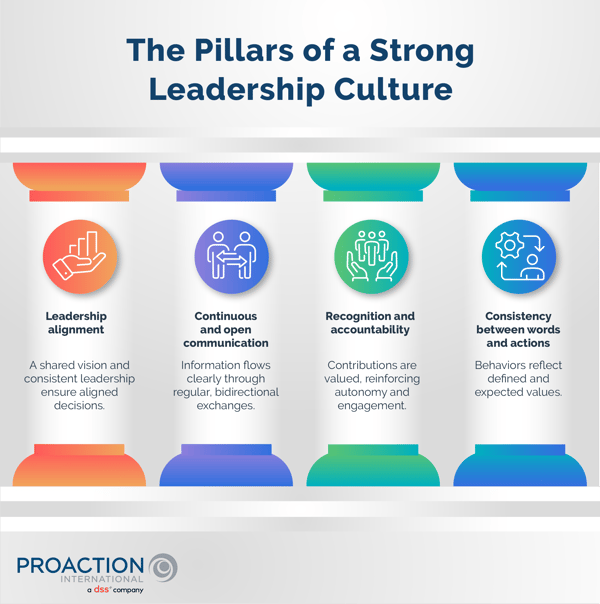
Leadership alignment
Leadership culture must be promoted at all levels, from top management to frontline managers.
Aligned leadership requires:
-
A clear and shared vision that supports transformational leadership
-
Consistent leadership skills
-
An appropriate stance for any situation in the work environment
Continuous and open communication
The frequency of communication and ways information, decisions, and feedback are shared are crucial to building a strong leadership culture.
Communicating effectively begins with:
-
Regular feedback loops
-
Two-way communication channels
-
Transparency, without confusion in decision-making
Recognition and accountability
Employee recognition shouldn’t only be given when spectacular results are achieved. Today’s organizations must also help team members feel valued by recognizing:
-
Individual efforts
-
Initiative
-
Skill development
Recognition often leads to accountability, which is also critical to creating a positive culture of leadership. Managers who value employee contributions promote autonomy and decision-making, fostering a climate where employees feel in control of their tasks, empowered to act, and engaged in the company’s success.
Consistency between words and actions
Consistent messages, decisions, and behaviors are extremely important for establishing a clear and effective leadership culture. Shared values and leaders' behaviors must be aligned to gain employees’ trust.

Benefits of a clear and shared leadership culture
Clarify expected behaviors
A company’s culture of leadership establishes a shared framework clarifying what is expected of managers beyond measurable goals. It promotes consistent behaviors and practices throughout the organization and helps reduce confusion. It also nurtures personal growth, empowering managers to become stronger, more inspiring leaders.
Align actions with strategic priorities
When management decisions reflect the organization’s priorities, employees better understand their role and what is expected of them. The alignment of vision, objectives, and operational management enables team members to better work together, fostering cohesion and efficiency.
Positively influence performance
By establishing consistent behaviors, practices, and decisions, leadership culture strengthens efficiency, speed of execution, and the ability to achieve objectives, to create a sustainable performance dynamic.
Facilitate change management
A strong leadership culture promotes adaptability. Managers become key resources to support employees during transitions, facilitate adoption, and rally them around new projects.
Promote engagement and retention
When the leadership culture is clearly defined and shared, it creates a reassuring and motivating workplace. Team members feel guided by common principles and more confident in their work. They become more motivated, engaged, and productive, which leads to higher job satisfaction and retention.
Reduce conflicts
Clear guidelines for expected behaviors reduces misunderstandings, and prevents contradictory decisions and ineffective tasks, creating a positive team’s culture and simplifying work relationships.
Foster accountability
A good leadership culture encourages autonomy, initiative, and ownership of goals. It empowers employees to make decisions at their own level and understand how their actions directly contribute to organizational success.
How to define and implement a strong leadership culture
1. Assess the current situation
Before building, you need to understand what is already in place. This involves conducting anonymous surveys to gather feedback on how employees and leaders perceive the current culture and management practices.
Individual interviews with leaders help to delve deeper, exploring their experiences, daily challenges, and understanding of managerial expectations.
Finally, observing practices on the floor – such as how meetings, decision-making, and priority management are conducted – provides concrete insight into the actual culture.
This assessment reveals which actions strengthen the ideal culture, which ones weaken it, and which ones require adjustment.
2. Define values and expected behaviors
The company’s values must be translated into concrete behaviors to create the desired culture. For example, promoting innovation means encouraging new ideas and solutions during meetings and giving employees the freedom to make mistakes. Valuing respect requires active listening, punctuality, and constructive conversations.
Making this shift from stated values to practical application is critical for the culture to come alive every day. Caroline Hardy, Director, Training and Coaching Programs at dss+, explains how the company works with its clients to define their managerial signature: “We work with the client to identify the values that are already strong within the organization and the managerial skills that need to be developed. Recognizing these strengths enables us to design programs that will nurture and reinforce them. These skills help bring the managerial signature to life, making it more precise, authentic, and distinctive.”
3. Train and coach leaders
A Gallup study found that participants in a manager training course focused on management best practices experienced up to 22% higher engagement than non-participants. In addition, the teams led by those participants saw engagement rise by up to 18%. Manager performance metrics improved between 20 to 28%.
Gallup, State of the Global Workplace 2025
Training managers is therefore a key factor in embracing the desired leadership culture. This involves leadership development – acquiring, enhancing, or strengthening leadership skills related to business strategy, operational execution, and emotional intelligence.
Educating leaders on topics such as leadership trends, communication, feedback, and their role in change management helps establish a common language across the management team. This shared understanding improves clarity around expected behaviors and how to adopt them.
In this regard, leadership coaching – whether individual or in groups – plays a crucial role. It enables managers to step back from their daily practices, adjust their approach, and develop the right reflexes. This personalized support allows for gradual and sustainable development, fostering long-term transformation.

4. Reinforce management routines
Leadership culture takes shape in everyday actions. Team meetings, employee check-ins, supervision tours, these moments encourage dialogue, help incorporate expected behaviors, and create a benevolent workplace leading to strong organizational culture and operational performance.
5. Involve employees throughout the process
Leadership culture is a concept that requires involvement from the entire team; it is built together. The full commitment of employees is essential to ensure the sustainability of the established culture. By consulting them from the outset through workshops, surveys, or focus groups the company fosters buy-in, a sense of belonging, and long-term engagement.
Employee participation also helps to better identify gaps between stated values and actual practices, while enriching the process with insightful frontline perspectives. This co-constructive approach lays fertile ground for an innovative organizational culture driven by collective intelligence.
6. Measure and adjust
The progression of leadership skills and the quality of practices can be measured using key behavioral indicators (KBIs) such as the Active Supervision Index, the Management Skills Index, and the Management Effectiveness Index. Tracking these metrics enables companies to see at a glance the strengths of each leader, and their areas of improvement, ensuring individual success.
Employee engagement can be measured through surveys, questionnaires, and one-on-one meetings. Based on the results, adjustments can be made where they will be most effective.
Tips to support successful leadership culture implementation
Building a strong culture requires structure and sustained effort. These strategies will help you facilitate the process, ensuring long-term organization's success:
-
Involve executive management: The leadership culture must be embodied by the highest levels of leadership. Executives must set an example so that the messages conveyed to higher-level leaders and frontline managers are credible. Their visible commitment legitimizes the process.
-
Appoint internal ambassadors: Identify managers or team members whose behaviors are consistent with the desired culture and turn them into references that can influence culture in a positive way within the organization. These ambassadors support their peers, relay information, and help bring the culture to life every day.
-
Roll out gradually: It’s better to proceed step by step rather than changing everything at once. Start by guiding transformation for a small group of key leaders or managers from a specific department to test and adjust the approach, and generate concrete successes that will serve as positive examples for the rest of the organization.
-
Communicate regularly on progress: Employees must be kept informed of the actions taken and the outcomes of the process. Maintain open and regular communication with teams, whether to share milestones achieved, lessons learned, or adjustments made. This reinforces transparency and gives real meaning to the change.
Build a strong leadership culture, combining people and performance
Between an empowering leadership, the engagement of hybrid teams, and the quest for meaning, the definition of today’s leadership culture is changing. Less authoritative, more human, it’s becoming a reliable framework in constantly changing work environments.
Companies that make an effort to define it, put it into practice actively, and make it evolve with their workplace start with a significant competitive advantage. Through their strong leadership culture, these organizations not only guide behaviors, but also promote well-being, support leaders’ success, and build loyalty, creating more motivated and productive employees.
While current trends call for greater flexibility, authenticity, and co-construction, investing in a leadership culture gives companies the means to keep up with the times, build a happy and productive workforce, and increase growth despite market challenges.