




What is leadership coaching?
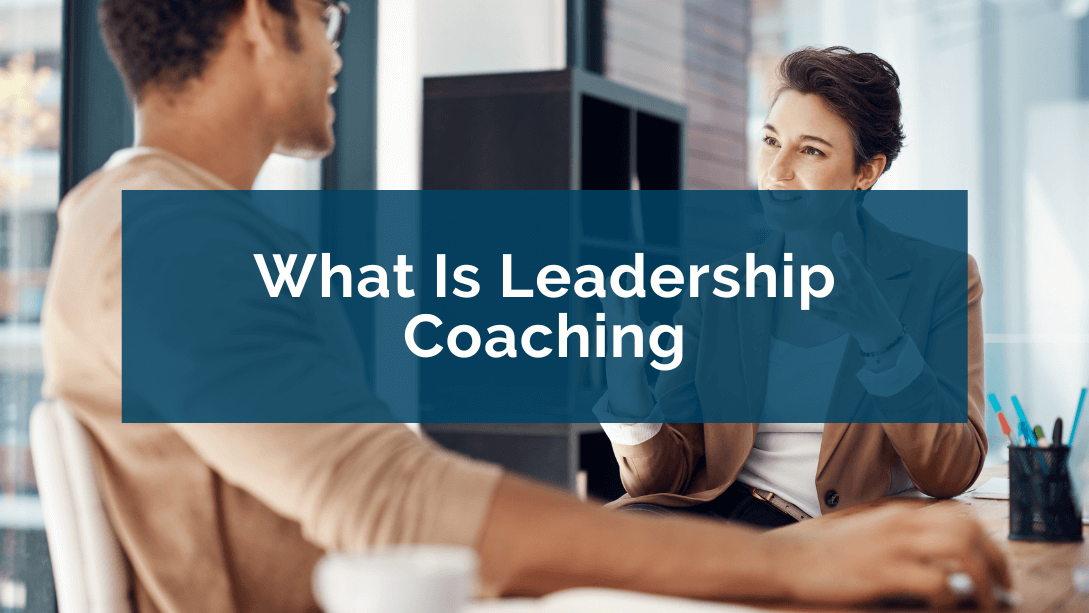
Coaching is partnering with clients in a thought-provoking and creative process that inspires them to maximize their personal and professional potential.
Leadership coaching offers a personalized and structured support program focused on developing the skills – behavioral and interpersonal – required by a leader or future leader to lead better.
Effective leadership coaching enables the coachee to develop a deep understanding of themself, explore and integrate new leadership skills and behaviors, strengthen their impact within their team, and achieve their performance goals.
Unlike leadership training, a standardized process for skill learning, or mentoring, an approach based on a mentor's experience, leadership coaching prioritizes the coachee's autonomy in developing their own solutions.
The coach's role in leadership development
The coach's mandate is not to train, advise, or lead; it is to bring the manager to take a step back, question themself, and mobilize their own resources to find relevant, effective solutions to their unique leadership challenges.
The coach stands as a benevolent but rigorous shadow, capable of confronting without offending. They create a safe space in which the manager can reflect, experiment, and develop the leadership abilities and traits that will transform them into a true leader.
The different types of leadership coaching
There are several effective leadership coaching models. The approach used can vary depending on the situation, challenges, and profile of the leader being coached:
- Strategic coaching is aimed at executives and leaders facing transformation, growth, or crisis to help them gain perspective, define their vision, and engage their teams. This type of leadership coaching focuses on holistic strategic thinking and change management rather than on individual management skills.
- Executive coaching targets senior leaders, supervisors, and managers to strengthen their leadership, strategic vision, decision-making, and team management effectiveness.
- Business coaching focuses on both the company's and executive's development. It is better suited for entrepreneurs and SME leaders.
- Behavioral coaching is a type of leadership coaching that helps identify and modify attitudes or reactions hindering performance or professional relationships. It enables managers to adopt the best behaviors to improve communication, collaboration, and leadership.
- Onboarding coaching is offered to new leaders joining an organization or leaders who have recently started a management role to facilitate their integration, build their credibility, and lay the foundation for effective leadership.
These types of leadership coaching programs can be combined. For example, executive coaching can incorporate a strong strategic or behavioral dimension, depending on needs.
Why is investing in leadership coaching important?
51% of companies with a strong coaching culture report higher revenue than their industry peer group.
Effective leadership is essential for driving growth and achieving lasting organizational success. With the goal of unlocking their full potential, leadership coaching helps leaders develop core management capabilities, enabling them to elevate their team's performance through stronger alignment, communication, and engagement, driving sustainable results.
Here are the top benefits of leadership coaching:
Benefits for the coachee
- Self-awareness: A better understanding of your strengths, limitations, and motivations.
- Emotional intelligence: The capacity to recognize, understand, and regulate your own emotions and other people's emotions.
- Self-confidence: The assurance to lead decisively and take ownership of your leadership role.
- Professional relationships: The ability to forge meaningful interactions and build trust through a more open and assertive attitude.
- Resilience: The strength to overcome obstacles, recover from setbacks, and maintain a positive mindset.
- Strategic vision: The aptitude to align decisions with long-term operational goals and anticipate challenges clearly.
Benefits for teams
- Empowerment: Granting team members autonomy fosters ownership of their work and boosts engagement.
- Motivation: Engaging leaders inspire and energize their teams, driving them to perform at their best every day.
- Team cohesion: Collaboration improves when leaders provide clear direction, align tasks with objectives, and navigate conflicts effectively.
- Communication: Regular, clear communication with your employees strengthens alignment and provides improvement opportunities.
- Feedback: Providing clear, constructive, and timely guidance helps workers learn and growth.
- Climate of trust: Authentic, supportive relationships between leaders and employees builds trust, boosting morale and motivation.
Benefits for the organization
- Strategic alignment: When leaders’ decisions consistently align with business goals, the entire organization moves cohesively toward success.
- Collaboration: Effective leaders unite diverse talents to foster cross-functional teamwork and break down organizational silos.
- Change management: Resilient managers keep their teams engaged and productive during times of transformation.
- Agility: Guided by strong leadership, teams can respond quickly and effectively to changing challenges and opportunities.
- Innovation: A forward-thinking leadership culture fosters creativity, initiative, and the development of breakthrough solutions.
- Culture of continuous improvement: Great leaders can foster an environment where teams consistently seek ways to enhance processes and performance.
Who can participate in leadership coaching programs?
A third of all Fortune 500 companies utilize executive coaching as standard leadership development for their elite executives and talented up-and-comers.
All leaders – senior executives, mid-level managers, and frontline managers – regardless of their situation, can take part in a leadership coaching program. However, specific profiles can reap significant benefits of such tailored support:
- New managers taking on their role face decision-making isolation and the need to quickly assert their leadership.
- Middle managers wish to develop their influence without direct hierarchical authority. They are often caught between executive management's strategic expectations and floor's operational needs.
- Leaders facing transformation like organizational restructuration or acquisition must adjust their vision, engage their teams, and make strategic decisions.
- Technical leaders are called upon to lead multidisciplinary teams and must transition from an expert role to an engaging management style.
What core competencies do leaders develop through coaching?
Active listening
Leaders develop active listening through leadership coaching by learning to fully focus on others without interrupting or jumping to conclusions. This skill goes beyond hearing words – it involves understanding tone, intent, and underlying concerns.
By actively listening to their employees, leaders enable them to feel valued and understood, which builds trust and encourages more open, honest communication.
Communication
Coaching helps leaders enhance their communication skills by focusing on clarity, constructiveness, and timing. They learn to deliver specific, actionable, and constructive feedback, avoiding critics and judgments. This not only improves individual performance but also creates a culture where continuous improvement is encouraged.
Emotional intelligence
Emotional intelligence is another key capability strengthened through leadership coaching. Coaches help leaders become more aware of their own emotions and better equipped to recognize and respond to the emotions of others.
This heightened awareness improves interpersonal relationships, helps manage conflict more effectively, and allows leaders to adapt their approach based on individual needs and situations.
Effective questioning
Leaders can also build powerful questioning skills, enabling them to guide conversations rather than direct them. Instead of providing immediate solutions, they learn to ask open-ended, thought-provoking questions that help employees reflect, analyze situations, and uncover their own answers. This approach fosters autonomy, critical thinking, and deeper engagement among team members.
Team empowerment
Leadership coaching also develop empowerment and delegation abilities. Leaders shift from a directive mindset to one that trusts employees to take ownership of their work. By empowering team members to make decisions and solve problems independently, they build confidence, accountability, and a stronger team.
Problem-solving
Another important skill developed through leadership coaching is problem-solving. Leaders learn to apply problem-solving methodologies to analyze situations, identify root causes, and prioritize actions. Rather than reacting to symptoms, they adopt a structured approach that encourages data-driven decisions and continuous learning.
By guiding their teams through these processes, leaders strengthen collective problem-solving capabilities and drive more sustainable, long-term solutions.
Self-awareness
Coaching strengthens self-awareness and reflective thinking. Leaders become more intentional about their behaviors, decisions, and impact on their teams. By regularly reflecting on their actions and outcomes, they continuously refine their leadership style, stay aligned with organizational goals, and drive ongoing personal and professional growth.
When to work with a leadership coaching expert?
Leadership coaching is especially valuable during periods of transition, rapid growth, or crisis, when traditional management practices – and even traditional leadership development programs – are no longer sufficient. This consistent, personalized support enables leaders to navigate organizational transformation, manage their teams effectively, and sustain productivity.
Leadership coaching can also be integrated into onboarding programs to help new managers quickly align with established leadership practices and culture.
Here are typical situations where leadership coaching can be leveraged:
- Starting a new position to maximize the impact of your first 90 days, establish your leadership style, and plan strategic priorities.
- Managing a crisis to improve communication, keep engagement high, and lead with clarity.
- Solving conflicts to rebuild trusted relationships among your team members and bring back cohesion.
- Dealing with high levels of disengagement to prevent psychosocial risks, restore job satisfaction, and instill a sense of purpose at work.
- Losing impact or credibility to redefine a more authentic management style and inspire trustful leadership.
How to choose the right coach?
Choosing the right professional can make a significant difference in the success of the leadership development process. A good leadership coach should not only demonstrate technical expertise, but also practical know-how and interpersonal skills.
Two key factors should be considered before sealing a coaching engagement:
Coaching skills
An expert that has coaching experience with profiles similar to yours will better understand your leadership challenges and responsibilities, as well as the realities of your industry. This field knowledge will provide highly personalized, relevant, and actionable support.
Compatibility with the coachee
The relationship between the coach and the coachee must be based on trust. Great communication and feedback skills, and the ability to create a space for critical thinking and cultivate a growth mindset are all signs of a fruitful partnership.
An exploratory session is often helpful in validating both interpersonal and professional fit to ensure a winning coaching relationship.
What are the terms of leadership coaching?
Leadership coaching can take several forms depending on the organization's needs, objectives, and culture.
Formats
- Individual: This is the most common format of leadership development as it enables personalized guidance based on a leader's unique challenges.
- Tandem: Two leaders (often at the same hierarchical level) are coached together to strengthen collaboration and peer development.
- Group: Several coachees (often from the same department or management level) work together on cross-functional issues, fostering collective intelligence.
- Hybrid: A combination of individual and group sessions to strengthen personal impact and team alignment.
Location
Leadership coaching can be delivered face-to-face, remotely (via videoconference), or through a hybrid approach. Face-to-face coaching is often preferred, as it allows the coach to observe individual leaders in their day-to-day work environment and provide guidance tailored to their specific challenges.
Remote coaching offers greater flexibility and is well suited for sessions such as quick check-ins, as well as coaching plan development and reviews.
Duration and frequency
On average, coaching sessions last 3 to 9 months, with a frequency of one session every 2 to 3 weeks. This ongoing support fosters long-term learning while allowing time for practical application between sessions.
Tools
- Self-assessment tools and questionnaires surveying values, sources of motivation, communication style, etc.
- 360-degree assessments to gather peer, colleague, and superior feedback.
- UTrakk platform to define leadership coaching plans, follow up on coaching sessions, and measure the progress of coachees.
- Journal and learning material to foster reflection and improvement.
What is the leadership coaching process?
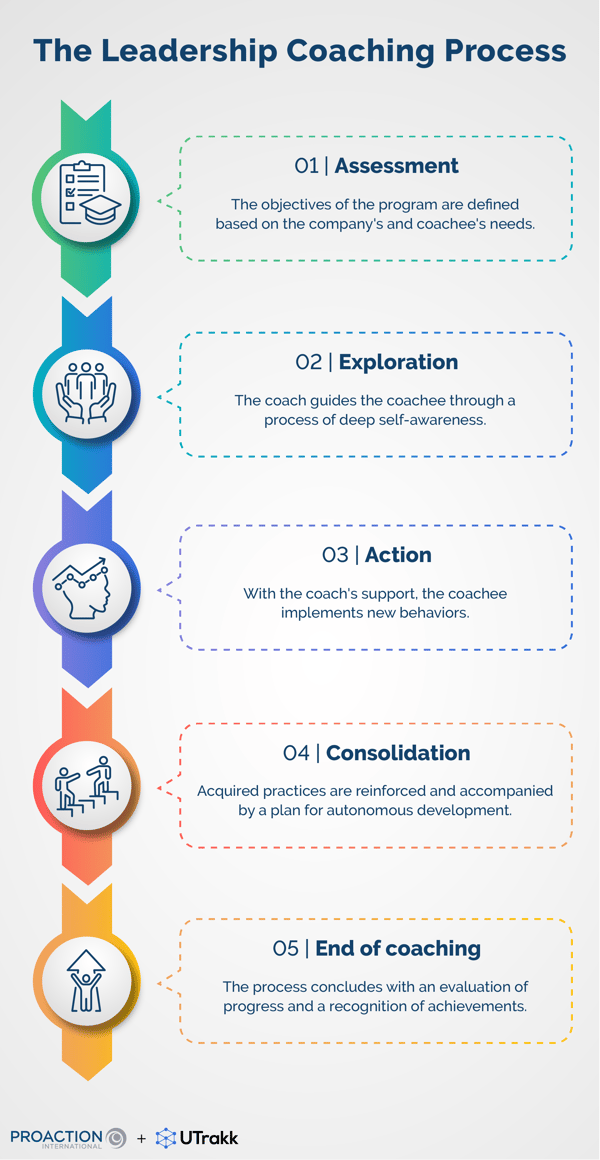
1. Assessment
Organizational diagnosis:
This step involves a reflective process carried out by the company, often in collaboration with an external partner such as a management consulting firm, to design leadership coaching programs that are tailored to its strategic and operational priorities, and organizational culture:
- Define the goals of the leadership development program.
- Identify who will get leadership coaching.
- Determine essential skills to develop.
- Align coaching with corporate culture and goals.
- Choose the right coaching approach.
Individual diagnosis:
Once the leadership development program has been defined, personalized coaching plans must be developed for all participants:
- Hold an exploratory meeting to establish a connection, build trust, and validate compatibility between the coach and coachee.
- Define the coachee's objectives and desired outcomes (e.g., perfect team management, build stronger assertiveness, or improve communication).
- Identify key behavioral indicators to measure success of the leadership coaching plan.
2. Exploration
The second step focuses on expanding leaders' self-understanding and awareness, helping them recognize how their actions and behaviors impact colleagues and employees. It helps them uncover new insights that lead to deep, transformative change:
- Provide self-assessment tools to help both the coaches and coachees better understand strengths and areas of improvement.
- Enable the coach to analyze strengths, behaviors, beliefs, and challenges to highlight coachee's personal traits.
- Foster in-depth work on values, leadership vision, and management style.
3. Action
Once a clear portrait of the leader has been established, it is time to take action – this is the transformation phase. During regular sessions over the defined period, the coach supports and challenges the coachee, asks targeted questions, and helps them implement lasting changes:
- Define and implement action plans aligned with set objectives.
- Try new behaviors and leadership styles in daily work situations.
- Deploy the right coaching methods and development strategies to achieve desired outcomes.
- Provide regular feedback to refine actions, reinforce what works, and address what may hinder progress.
Each session enables strategic reflection and practical implementation, both aligned with the initial objectives.
Thanks to the coaches, our managers now feel fully confident and better prepared to fulfill their role with their teams.
Gérard Robitaille, Financial Controller in KEFOR case study
4. Consolidation
At this stage, the transformation is underway. The goal is to stabilize newly acquired management skills and prepare the leader to operate autonomously once the coaching ends – shifting from a temporary change in behavior to a sustained evolution in leadership:
- Consolidate key learnings.
- Identify behaviors to maintain, monitor, and avoid.
- Develop a maintenance plan or post-coaching roadmap to sustain momentum and continue progressing independently.
- Recognize results collected from peer feedback and KPIs.
5. End of coaching
The leadership coaching process concludes with a final session that includes a debriefing and a discussion of future goals. This session should be conducted positively, celebrating progress, and ensuring the coachee feels fully empowered to continue their development:
- Assess the coachee's overall progress.
- Evaluate their goal achievement rate.
- Share feedback, successes, and future opportunities.
I've seen our managers flourish through leadership coaching. They're more present on the floor and more confident. The leadership development approach enabled them to become excellent leaders.
Karen Maynard, Director of Human Resources in Zavida case study
Make your leaders and organization grow
Leadership is no longer defined by authority, control, or certainty. Today, it is rooted in self-reflection, continuous learning, communication, and adaptability. And this is exactly what leadership coaching enables – an inner transformation that drives both personal and collective impact.
The challenge extends far beyond individual development. When embedded within an organization, leadership coaching becomes part of its culture, fostering work environments that are healthy, empowering, engaging, and high-performing.
By coaching leadership teams and encouraging them to adopt a coaching mindset with their employees, organizations cultivate a leadership style that is less directive and more inspiring. This approach promotes autonomy, leverages collective intelligence, and reinforces continuous improvement – key pillars of sustainable organizational performance.
In this context, incorporating leadership coaching programs fully supports operational excellence. Investing in this type of leadership development creates a lasting growth dynamic across the organization, placing people at the heart of its strategy.