






The challenges of business leaders today
The business and economic landscape is undergoing significant upheaval, driven by rapid technological advances, shifting workforce expectations, and growing social and environmental responsibilities.
Advanced technologies and AI
The emergence of Industry 5.0 technologies, with innovations like artificial intelligence (AI), the Internet of Things (IoT), and advanced data analysis, redefines organizational models. These interconnected systems require leaders to gain a deep understanding of how such technologies can be used to improve daily performance. It is no longer only about ensuring operational continuity but establishing a synergy between humans and machines – all while keeping the crucial aspect of ethics in mind.
Environmental and social responsibility
With climate change and ethical labor concerns comes an increased responsibility for businesses to have a positive ecological and social impact. Managers are called upon to adopt practices that reconcile economic performance with respect for the environment and people.
New expectations in the workplace
Workers' priorities are changing. New talents from Generation Z aspire to a fair balance between professional and personal life. They want to work in organizations that value diversity, personal fulfillment, and recognition. Leaders must consider these new demands to keep their teams engaged and high-performing.
Evolving leadership roles
Beyond technological and cultural challenges, management itself is undergoing a profound transformation. Traditional authoritative leadership styles are no longer effective in a world where collaboration prevails. Today’s leaders must adopt a collaborative mindset. Vertical authority is giving way to team dynamics built on open communication, mutual respect, trust, and empowerment.
Disruption and incertainty
The rapidly evolving nature of today’s business world demands leaders who can navigate uncertainty. Making decisions during times of crisis and economic shifts – while ensuring low production costs and high margins – requires capabilities that are not typically part of traditional leadership skill sets. Managers must change their mindset and habits to embrace a more agile leadership approach.
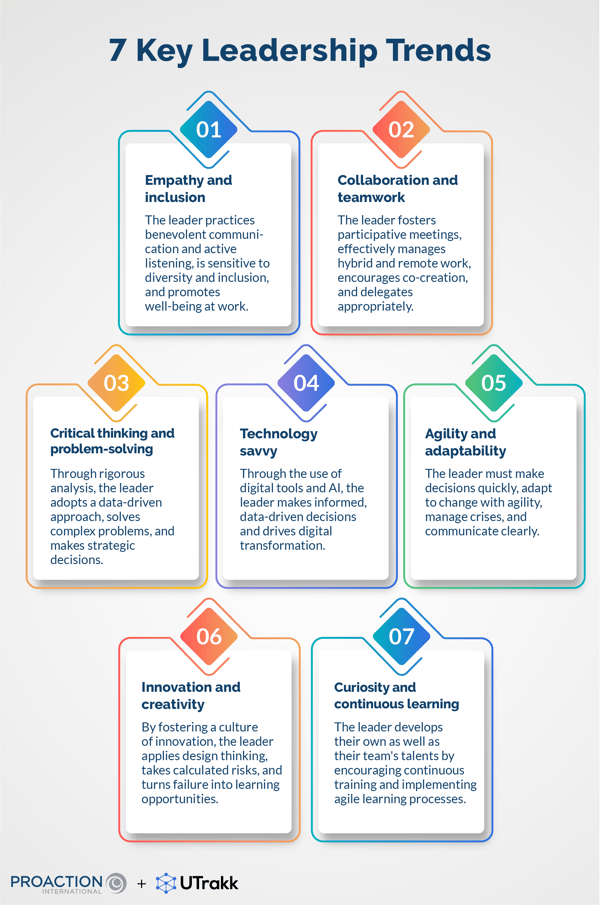
7 Key leadership trends to guide your organization to success
Today’s leadership trends are a combination of management competences, human behaviors, and AI literacy that meet the challenges of the current business landscape and new expectations of the modern workforce.
1. Technology and AI proficiency
Leaders who master technology and AI aren't just keeping up with the times. They're setting their businesses up for success.
Bryan Ackermann, Head of AI Strategy & Transformation, Korn Ferry
With the rise of artificial intelligence, leaders must become proficient in leveraging AI tools in key areas. They need to learn how to use these emerging technologies to improve efficiency, solve complex problems, and support decision-making, while remaining mindful of AI’s ethical boundaries.
Leaders must also guide their teams through this digital transformation, ensuring that technology supports and enhances employees’ work rather than replacing them.
Tips to improve your technology and AI skills:
-
Experiment with AI tools regularly by integrating them into daily tasks such as data analysis, reporting, or decision support.
-
Start small pilot projects to test AI use cases in real business scenarios.
-
Develop ethical and critical thinking skills to assess outputs, challenge results, and ensure responsible AI adoption.
2. Resilient and adaptative leadership
Continuous change makes existing assumptions and beliefs irrelevant. You must therefore be ready to change beliefs and ways of operating that have served you well over the years.
Disruptions such as economic uncertainty, climate change, and workforce volatility are pushing leaders to become more resilient than ever. This requires anticipating challenges, responding quickly to market fluctuations, adjusting priorities in real time, and maintaining clear communication to keep teams aligned.
The ability to continuously evolve is critical in times of rapid change. Leaders must build flexible processes that enable organizations to prepare for multiple scenarios and thrive, no matter what lies ahead.
Tips to become a resilient, adaptative leader:
-
Anticipate change proactively by monitoring trends, risks, and weak signals to stay ahead.
-
Make decisions with agility by acting quickly on available data, testing ideas, and adjusting course as conditions evolve.
-
Develop personal and team resilience by managing energy, encouraging learning from setbacks, and supporting well-being.
3. Critical thinking and problem-solving
Effective leadership fosters critical thinking and intellectual curiosity by encouraging managers and teams to ask questions, seek diverse perspectives, and challenge existing assumptions to solve problems sustainably and drive continuous improvement.
For example, practices such as scenario analysis, design thinking, and post-mortem reviews help identify root causes and develop effective, long-term solutions.
Tips to enhance your critical thinking and problem-solving skills:
-
Ask “Why” and “What if” questions to challenge assumptions and explore alternative explanations or scenarios.
-
Apply structured problem-solving frameworks such as design thinking or root cause analysis (or 5 Whys) to break down and systematically address complex issues.
-
Test ideas and anticipate potential outcomes before implementing solutions in real-world situations by engaging in scenario planning and simulations.
4. Innovation and creativity
Innovation and creativity are essential business strategies for any organization seeking a competitive advantage and long-term success. Today’s leaders encourage experimentation and calculated risk-taking. They do not hesitate to try new approaches and think outside the box.
They also value curiosity, boldness, and fresh ideas. This fosters a culture in which failure is seen as a learning opportunity and motivates employees to propose and test solutions that haven’t been tried before.
Tips to drive innovation and creative thinking:
-
Encourage a safe-to-fail environment where employees can experiment without fear of mistakes. This also creates a climate of psychological safety, which is crucial in today's workplaces.
-
Foster collaboration between different teams and departments to combine diverse perspectives and spark new solutions.
-
Allocate regular time for creative thinking and brainstorming beyond routine tasks.
5. Leadership development and continuous learning
With the evolution of technology, emerging leadership trends, and an ever-changing business landscape, leadership skills must be continuously updated. Managers need to actively engage in ongoing education to avoid skills gaps and remain relevant.
HR departments can support this by implementing personalized leadership development programs, offering regular training, or providing tailored coaching to help leaders stay current. Managers can also take initiative by reading books and articles, attending online courses, and participating in mentorship opportunities.
This approach helps build a culture of continuous improvement, ensuring strong organizational performance while boosting employee motivation and engagement.
Tips to continuously develop your leadership skills:
-
Seek out courses, webinars, and microlearning opportunities to build specific skills and stay current with industry best practices.
-
Reach out to experienced leaders for guidance and ask colleagues and team members for honest feedback to identify areas for growth.
-
Regularly reflect on your experiences, track development, and adjust learning goals to ensure continuous improvement.
6. Collaboration and teamwork
The best ideas and solutions often emerge through cross-functional collaboration. Collaborative leadership promotes co-creation, shared responsibility, and the inclusion of ideas from all levels of the organization. Interdepartmental committees and group projects are effective ways to foster teamwork, drive innovation, and cultivate a sense of collective achievement.
Furthermore, as many organizations worldwide adopt hybrid models or fully remote teams, a leader’s ability to unite team members, maintain effective collaboration, inspire trust, and nurture strong relationships becomes increasingly critical.
Tips to promote collaboration within your team:
-
Create opportunities for team members from different departments to work together on shared goals, fostering diverse perspectives and new ideas.
-
Use digital platforms to facilitate real-time collaboration, especially for hybrid teams and fully remote workers.
-
Encourage non-violent communication, active listening, and respect for different viewpoints to create a psychologically safe environment for collaboration.
7. Emotional intelligence and humanity
Good relationships and empathy have always been part of the equation in truly motivating others, but they are becoming ever more important as we increasingly supervise from a distance or online.
A leader must first and foremost be human before being a manager. Soft skills such as empathy, ethical awareness, open-mindedness, and emotional intelligence are increasingly important. In a world where employees seek more than just a job, leaders must foster a supportive environment in which everyone feels recognized and safe. This involves actively listening, communicating effectively, and promoting equal opportunities and inclusion.
Moreover, leaders must be committed to preserving employee well-being and cultivating a positive work culture. They understand that these elements are essential for engaging teams, ultimately creating healthier and more productive organizations.
Tips to cultivate emotional intelligence:
-
Actively listen to your employees, seek to understand their perspectives, and acknowledge their feelings without judgment.
-
Focus on effective communication, conflict resolution, and building strong, collaborative relationships with your team.
-
Encourage honest feedback from peers and team members, and use it to identify areas for growth in interpersonal skills.
Leadership strategies to ensure success today and tomorrow
In today’s rapidly evolving business environment, leadership is no longer defined solely by authority or hierarchy. Modern leaders must embrace a multifaceted approach that combines technological proficiency, strategic and creative thinking, and emotional intelligence.
By adopting top leadership trends, managers can guide organizations through uncertainty, foster innovation, and create a culture where employees feel empowered and motivated to perform at their best. These key trends are not temporary fixes but enduring strategies that future-proof businesses and support long-term growth.
Ultimately, the leaders who will succeed are those who balance organizational performance with purpose, ethics, and empathy. By continuously learning, adapting, and driving human impact, they can navigate complexity, inspire high-performing teams, and build organizations that are resilient, innovative, and ready for the challenges of tomorrow.