





What is Gemba?
The Japanese word “Gemba” refers to “the real place” or “actual place”. In the common language, it’s used to name the place where the action happens.
In the context of Lean Management, and more specifically Lean Manufacturing, the Japanese term identifies the physical location where work is done. In an industrial or manufacturing facility, Gemba is the factory floor, the supply chain, or the workstation. However, in the service sector, it could be the customer reception area, the counter, or a business process.
Gemba is the starting point for creating added value and continuously improving processes in the workplace. In this sense, it offers three strategic advantages:
-
Visibility: Gemba exposes the processes being carried out, problematic areas, unplanned downtime, and implemented adjustments.
-
Dialogue: It engages employees on the floor, breaks down hierarchical silos, and makes everyday realities tangible.
-
Responsiveness: It helps trigger immediate actions (quick fixes) and identify opportunities for continuous improvement (Kaizen).

Gemba and Genchi Genbutsu: “Go and see for yourself”
In Lean philosophy, Gemba is often coupled with the concept of Genchi Genbutsu, which means “go and see for yourself” or literally, "actual place and actual thing". Linked to the Toyota Production System (TPS), this method invites leaders and supervisors to see the reality of the situation for themselves, rather than relying on interpretations or reports.
The idea is simple: to understand a problem, you must go where it occurs, see the actual work environment, and engage in conversations with those involved.
Genchi Genbutsu isn’t a tool, but a state of mind and continuous learning approach. It encourages managers to be curious, humble, and sensitive to the realities of the floor.
Gemba in Lean Management: Gemba Kaizen and shop floor management
Gemba is part of a continuous improvement approach called Gemba Kaizen. The term "Kaizen" implies small, incremental changes. Coupled with Gemba, it refers to the implementation of incremental and on-going transformations oriented toward the factory floor.
Integrating the principles of Gemba and Kaizen into management practices brings many benefits that reinforce continuous process improvement and strengthen the relationship between leadership and the floor:
-
Kaizen initiatives: Rather than pushing solutions, managers encourage employees to identify opportunities for continuous improvement, empower them, and work with them to develop corrective measures.
-
Learning-based management: To the Gemba, decisions aren’t based on assumptions or isolated data, but on concrete and observable insights. It’s about adjusting strategies based on the realities of the floor.
-
Increased collaboration: Gemba promotes collaboration between departments. By observing processes from end to end, stakeholders can better understand where frictions are and work collaboratively to optimize them.
-
Stronger managerial credibility: By regularly going to the Gemba, leaders demonstrate that they are aware of the constraints, realities, and opportunities of the floor, and that they are committed to improving work processes and employee well-being.
-
Greater consistency between strategy and action: Strategic goals are linked to operational issues identified on the Gemba, which ensures that improvement plans are based on tangible observations.
What is a Gemba Walk?
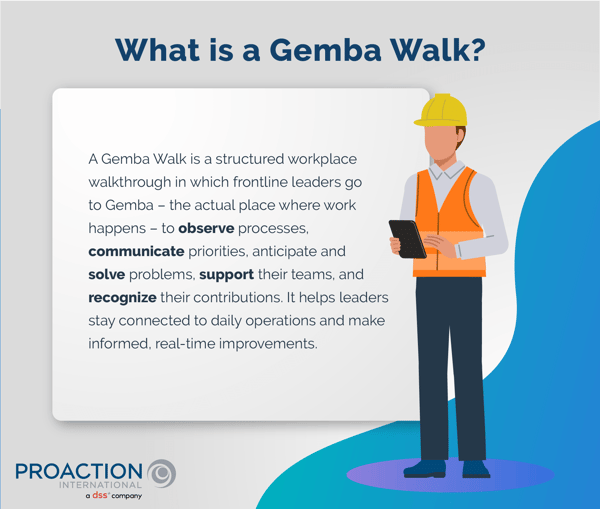
According to the Lean Enterprise Institute, the Gemba Walk is a management practice that involves going out into the field (the Gemba) to directly observe the actual situation, ask questions, and initiate action.
The Gemba Walk enables leaders to observe processes, communicate priorities, anticipate and solve problems, support their teams, and recognize their contributions. It helps them stay connected to daily operations and make informed, real-time improvements.
A structured practice, the Gemba Walk has a clear objective, a defined route, specific and comprehensive questions, and is systematically followed up.
The importance of Gemba Walks in industrial environments
In manufacturing businesses, Gemba Walks are an essential strategy to understand performance beyond operational dashboards. By going on the floor, leaders reconnect KPIs to the reality of the workplace, where value is created, waste is eliminated, and relationships are strengthened.
Go beyond key performance indicators
In all companies, management teams rely on KPIs to manage operations. Even though they’re useful, these metrics don't tell the whole story:
-
Invisible side effects (wear and tear, health and safety risks, poorly applied processes, etc.);
-
Recurring gaps that add up to costs;
-
Difficulties encountered on a daily basis by operators;
-
Potential improvements.
With Gemba Walks, managers no longer rely solely on reports; they compare data with on-site realities to make accurate, efficient decisions.
Bring management and operators closer
Gemba Walks act as a bridge between different management levels and frontline teams. By being present on the floor, leaders send a strong message, showing they’re interested in their employees’ work, they want to understand their challenges, and they value collective participation in improvements.
This proximity strengthens the Lean approach but, more importantly, builds trust and creates a collaborative and positive workplace. It gives operators a voice, allowing them to share obstacles to productivity and improvement solutions. In turn, managers gain valuable insights into process challenges and hidden improvement opportunities.
Identify and eliminate waste
Lean thinking identifies three main categories of dysfunctions that negatively impact companies’ performance and profitability:
-
Muda (waste): Activities that consume resources but don’t create customer value.
-
Muri (overburden): Excessive workloads that strain employees, machines, or processes.
-
Mura (unevenness): Inconsistencies or irregularities in production processes.
The three Ms are closely interconnected – Mura leads to Muri, which often results in Muda. This is where an effective Gemba Walk becomes invaluable, providing real-time insight into these three sources of inefficiency.
In the workplace, sources of waste often go unnoticed. However, by enabling direct observation of the value stream, movements, and interactions, Gemba Walks reveal these obstacles that key performance indicators alone can’t. This practice becomes a great visual investigation tool, helping leaders identify wasteful activities, get a deep understanding of their root causes, and engage teams in eliminating them.
Reconnect leadership to real value added
A Gemba Walk refocuses leadership on these crucial questions – where is the added value? How is it produced? What day-to-day tasks contribute to creating it or slowing it down? It transforms the leader's role, shifting from one who commands to one who learns, from one who verifies to one who understands, from one who imposes to one who facilitates.
Gemba Walks encourage leaders to engage in a business process, here and now, to solve problems and continuously create value.
7 Steps to implement Gemba Walks in your plant
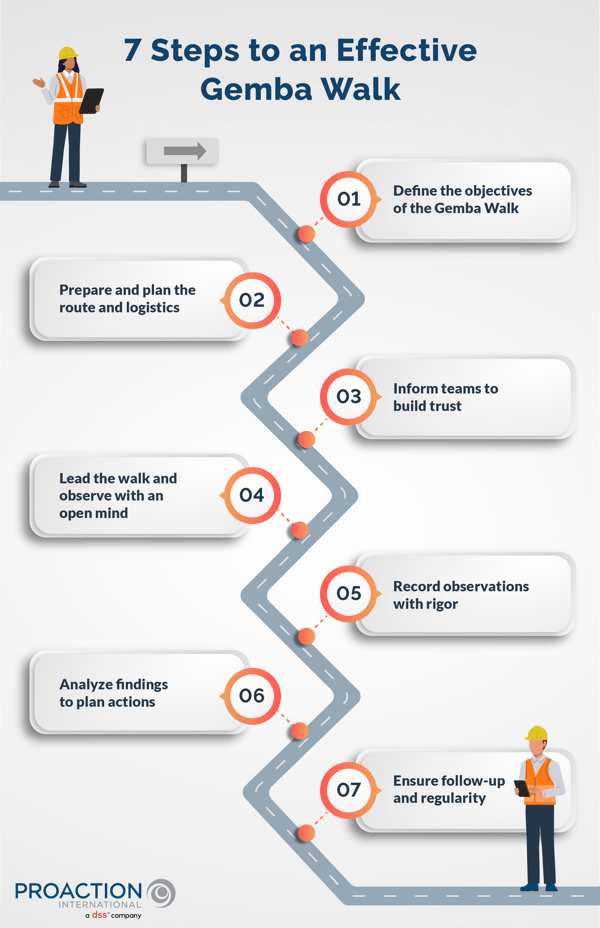
1. Define the objectives
Before walking the shop floor, you need to know why you’re conducting a Gemba Walk. Define clear goals – identify wasteful activities, strengthen health and safety, or enhance product quality. These objectives will guide what must be checked during Gemba visits (e.g., compliance with standards, workstation organization, access to equipment, etc.).
2. Prepare and plan the route
The Gemba Walk shouldn't be done randomly. Establish a structured itinerary, choose the right times throughout the day, and collect existing data (from operational dashboards, stream maps, manufacturing KPIs, etc.) to guide your observations.
Define the duration and frequency. A Gemba Walk takes about 20 to 60 minutes and must be regularly carried out to have a real impact. Depending on the manager's role and the organization's maturity, the Gemba Walk can be performed daily, weekly, or monthly.
Finally, create a Gemba Walk checklist with the questions you want to ask and the items to check based on your objectives.
3. Inform teams to build trust
It’s crucial to inform in advance employees who will be involved in the Gemba Walk. Explain that the goal is to learn, not to criticize. Talk to them about the process so they feel confident and willing to collaborate. Discussions with employees should be constructive and transparent.
Share your Gemba Walk checklists. By asking your colleagues for their perspective, you may be able to identify overlooked items, blind spots, or specific elements you hadn't anticipated during preparation.
4. Lead the walk and observe with an open mind
When conducting Gemba Walks, prioritize listening and observation: observe without interrupting, ask open-ended questions, and focus on the actual process – not on individuals. Avoid any criticism on the spot.
5. Record observations with rigor
Carefully document your observations (dysfunctions, waste, non-conformities, etc.) and any employee feedback. Take notes and add photos as needed to facilitate analysis and prioritize actions.
6. Analyze findings to plan actions
After the Gemba Walk, make time to debrief with your teams to identify the potential root causes of the problems observed. Propose both short-term and long-term actions, involving employees every step of these continuous improvement initiatives.
7. Ensure follow-up and regularity
To ensure successful implementation, Gemba Walks must be conducted regularly as well as closely monitored. Schedule recurring Gemba visits, track progress, and adjust your approach to embed continuous improvement into your company’s Lean Management routines.
Best practices for a successful Gemba Walk process
Train leaders on Gemba Walks
The practice of Gemba Walks requires specific skills. It's not enough to simply plan regular walks, you must:
-
Learn to ask questions and communicate effectively through active listening, rephrasing, etc.
-
Demonstrate humility by acknowledging that you don’t know everything.
-
Work on note-taking, photography, and annotation to document observations clearly and precisely.
-
Master problem-solving tools like PDCA, 5 Whys, etc.
-
Simulate Gemba Walks to sharpen observation and conversation skills, and learn to wait before taking action.
Pro tip: Field training, led by a coach or an experienced leader, is very effective to master the art of Gemba Walks.
Integrate Gemba Walks in the management routine
To ensure that Gemba Walks become a standardized practice within your organization, it must be an integral part of the management routine.
-
Define the appropriate frequency (daily, weekly, or monthly) depending on the context.
-
Save dedicated time in managers' calendar.
-
Integrate the Gemba Walk into team rituals (Short Interval Management, kick-off meetings, transition checkpoints, etc.
Measure the impact of Gemba Walks
To assess the impact of Gemba Walks, it’s critical to combine quantitative and qualitative metrics.
Quantitative indicators provide a concrete way to measure operational performance, particularly through the following metrics:
-
Number of improvement actions carried out
-
Unplanned downtime
-
Yield rate
-
Defect rate
-
Cycle time
-
Waste
At the same time, qualitative metrics provide a human and cultural interpretation of the practice, based on:
-
Operator feedback
-
Feeling of recognition and being listened to
-
Number of shared ideas
-
Perception of frontline management
-
Lean project adoption rate
Measuring these two types of data provides rich information on operational and human benefits generated through Gemba Walks.

Gemba Walk in the era of new technologies
The digital transition, the rise of digital tools, and Industry 5.0 raise the following questions: Is Gemba still relevant? Could it be replaced with remote monitoring?
In highly automated or remotely controlled factories, the Gemba Walk isn’t disappearing; it’s changing. Even if direct human interactions are less frequent, the approach still has the same purpose – going to where added value is created, whether it's a physical workstation or a digital space.
In these environments:
-
Incidents, performance drops, or technical alerts still need to be monitored. A Gemba Walk can consist of on-site analysis of a monitoring screen or historical data to understand what’s causing the gap.
-
Digital interfaces allow managers to visualize workflows, ask questions to the technical team, and compare data with observations on the floor.
-
The Gemba Walk now extends to the factory's digital environments. A leader no longer only observes operators’ activities but also human-machine interactions, system alerts, and real-time adjustments.
Overall, the objective remains the same. It’s about understanding operations, identifying variances, and supporting teams in problem-solving. Even in a digitalized environment, leaders must maintain tangible contact with critical points, whether physical (robotic cell, conveyor, or maintenance station) or virtual (dashboards, lines of code, or data flows).
Improve your Gemba Walks’ efficiency with UTrakk
With the UTrakk digital platform, every Gemba Walk becomes a structured and traceable ritual focused on business performance. Embedded in daily management, the DMS combines the precision of key performance indicators with the richness of human interaction on the floor to anticipate and solve problems and ensure continuous improvement efforts.
With its comprehensive set of robust features, this Gemba Walk software enables leaders to:
-
Structure and plan Gemba Walks: Digitalized tours are scheduled on a regular basis in a standardized agenda, and structured using checklists.
-
Identify problems: Customized around SQCDPE performance objectives, Gemba Walk checklists support the observation of key control points, enabling rapid detection of performance gaps, waste, or risks on the floor.
-
Turn observations into actions: Each variance or opportunity identified can be immediately converted into a corrective action or improvement project, assigned to an owner with a clear deadline.
-
Ensure close monitoring of actions and projects: Actions and improvement initiatives can be linked to management rituals (meetings, committees, etc.) to ensure rigorous and continuous follow-up.
-
Drive performance in real time: Data collected during Gemba Walks is centralized in dynamic dashboards, providing instant visibility into the effectiveness of implemented solutions and operational trends.

The hybrid Gemba Walk: Combining human presence and digitalization
The Gemba Walk remains at the heart of any Lean approach today. It brings leaders closer to the reality of the floor, where operational excellence is built. However, the floor has evolved, extending beyond the factory walls into the digital sphere.
This evolution has given rise to a new concept: the hybrid Gemba Walk. It combines physical presence – essential for understanding processes – with digital support – which enables the tracking of observations and actions and helps sustain a high level of performance. This represents a new form of managerial proximity where leadership is able to observe, listen, and analyze, both on the floor and through data flows.
Lean daily management tools such as UTrakk make it possible to orchestrate this alliance between operational and digital environments, giving the Gemba Walk a more structured and robust framework. The challenge is no longer simply to conduct Gemba Walks, but to sustain a continuous practice of observation and improvement, supported by both strong floor presence and the power of new technologies.