






Why OEE matters in manufacturing operations
Improving OEE is a powerful strategy for manufacturers looking to enhance performance and stay competitive. By addressing inefficiencies across availability, performance, and quality, they can unlock significant operational and financial gains.
Here is why OEE improvement is essential for sustainable manufacturing success:
- Increased overall productivity: Improving OEE ensures that equipment runs when needed, at optimal speed, and produces high-quality output. This reduces lost production time and enables higher throughput without additional investment. As a result, manufacturers can produce more with the same assets.
- Reduced production costs: By identifying and addressing the root causes of downtime events and inefficiencies, companies can significantly lower operational costs. Reduced scrap, fewer breakdowns, and smoother manufacturing processes all contribute to cost savings, leading to improved margins and more competitive operations.
- Real-time visibility into performance loss: As OEE breaks down performance into availability, performance, and quality metrics, losses are easier to identify and analyze. This transparency helps teams prioritize continuous improvement initiatives to ensure the greatest impact. It also supports consistent monitoring and accountability.
- Data-driven decision-making: Overall Equipment Effectiveness provides quantifiable metrics that help leaders make informed operational decisions. Instead of relying on assumptions, teams can act based on real performance data. This leads to more effective strategies and targeted improvements.
- Improved resource utilization: Higher OEE means better use of existing resources, avoiding underutilized equipment or idle labor. It ensures that materials are used efficiently, reducing unnecessary consumption and waste. This optimization helps maximize return on assets and workforce productivity.
- Enhanced product quality: A focus on OEE highlights quality issues, prompting corrective actions to reduce defects. Producing more right-first-time products lowers rework and scrap rates. This not only saves costs but also strengthens brand reputation.
- Consistent on-time delivery: Reliable and efficient production processes improve the ability to meet delivery deadlines. Fewer disruptions mean more predictable output and better planning. This consistency also enhances customer trust and satisfaction.
- Strong culture of operational excellence: Monitoring OEE encourages teams at all levels to identify problems and implement solutions proactively. It fosters collaboration, accountability, and engagement across the organization, creating a mindset focused on sustained performance improvements and long-term success.
10 Strategies to improve OEE in your plant
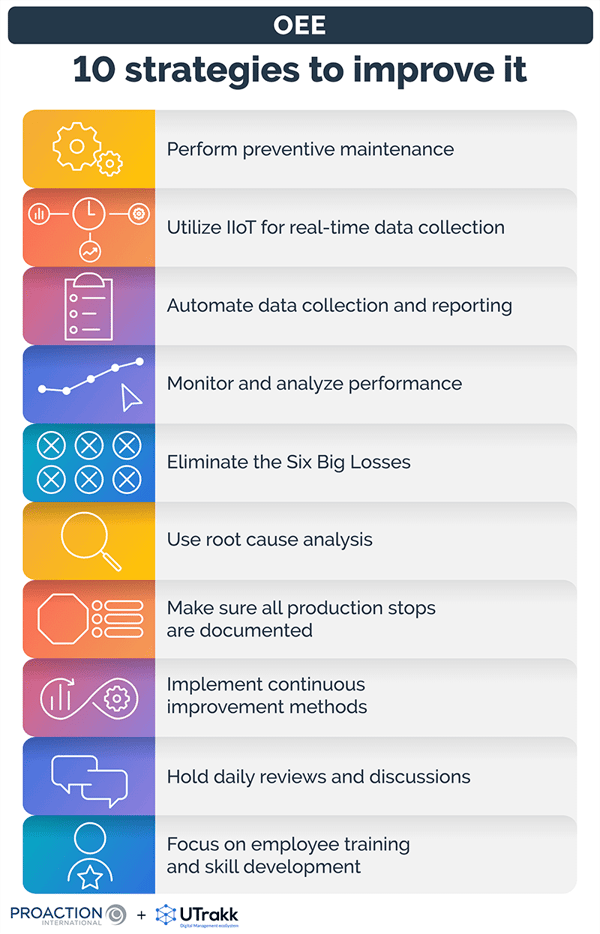
1. Eliminate the Six Big Losses
The Six Big Losses describe the primary causes of waste and lost production time in terms of availability, performance, and quality:
- Equipment failure: Machine downtime caused by breakdowns and unplanned stops.
- Setup and adjustments: Planned downtime for production preparation, tool changes, or production adjustments.
- Idling and minor stops: Short interruptions that are quickly resolved by operators.
- Reduced speed: Equipment operating at lower speed than standard.
- Process defects: Defective parts produced during normal cycles.
- Reduced yield: Defects produced during startup, before stabilization.
Identify and eliminate these losses to directly improve OEE performance.
2. Perform preventive maintenance
Well-maintained equipment is essential for smooth production. Schedule and perform regular maintenance tasks to prevent unexpected breakdowns. This includes inspection, lubrication, replacement of worn parts, and any other scheduled maintenance activities.
Regular preventive maintenance allows you to:
- Prevent unplanned production downtime by identifying and correcting issues before they become serious.
- Extend the equipment’s lifespan, and ultimately its availability, by keeping it in good working condition.
- Maintain the quality of each part or product by preventing breakdowns that could compromise it.
3. Use IIoT for real-time data collection
Take advantage of new technologies available to you. The Industrial Internet of Things (IIoT) enables real-time, accurate data collection directly from production equipment and machines when they are connected to a network.
This strategy helps improve availability and quality through:
- Real-time monitoring of equipment performance, enabling quick intervention in the event of a problem.
- Thorough data collection process, accelerating analysis of production, maintenance, and quality information.
- Forecasting of maintenance needs, facilitating regular maintenance planning.
4. Automate data collection and reporting
Automating data collection and reporting greatly simplifies the process of monitoring overall equipment effectiveness.
With an automated process, you can:
- Eliminate human errors and ensure data accuracy.
- Save time by eliminating tedious manual data collection tasks.
- Generate reports in real-time, providing an immediate overview of OEE performance.
5. Monitor and analyze performance
The Pareto principle (or 80/20 rule) states that 80% of problems stem from 20% of causes, meaning that most non-conformities or inefficiencies are generally caused by a small number of factors.
Apply the Pareto principle to identify the root causes of problems or disruptions in your manufacturing processes – that is, the 20% of causes responsible for 80% of the issues. Then, prioritize the problems to address based on their potential impact on performance.
This methodology allows you to:
- Assign efforts and resources where they will have the greatest impact.
- Stay focused by not diluting efforts on less urgent matters.
- Improve efficiency and optimize the overall performance of your operations.

6. Use root cause analysis
Root cause analysis, also known as the 5 Whys method, involves identifying the underlying causes of production problems.
To perform this analysis, define the problem, identify its root cause by asking “Why?” five times, implement solutions, and measure their effectiveness.
Root cause analysis enables you to:
- Understand the root of problems and find solutions to solve them sustainably.
- Prevent problems from recurring by addressing root causes.
- Improve quality by eliminating problems at the source.
7. Document all production stops
To improve OEE, every production stop must be documented and analyzed.
With this information, you can:
- Identify trends and recurring issues to address them effectively.
- Reduce unplanned downtime by resolving identified problems.
- Encourage operators to drive continuous improvement by actively involving them in finding solutions.
8. Implement continuous improvement methods
Continuous improvement is a gradual process aimed at constantly enhancing performance.
Use continuous improvement methods to strengthen:
- A continuous improvement culture within your company.
- Optimization of operational processes.
- Involvement of all team members in finding solutions to improve OEE.
9. Hold daily meetings
Daily production meetings provide opportunities for teams to stay informed about significant improvements or problems with OEE. These meetings enable teams to quickly identify, report, and solve issues that could hinder equipment performance.
These meetings allow you to:
- Monitor OEE and other manufacturing metrics in real time.
- Quickly identify issues and develop action plans.
- Facilitate communication among teams.
10. Offer training and coaching
Well-trained employees are key to maintaining equipment, monitoring production, and responding quickly to problems.
Invest in training and coaching to:
- Empower your operators to use equipment properly and implement the right solution when problems arise.
- Foster a culture of accountability for operational performance within your plant.
- Involve employees in OEE improvement initiatives and targeted interventions.
How to calculate OEE performance
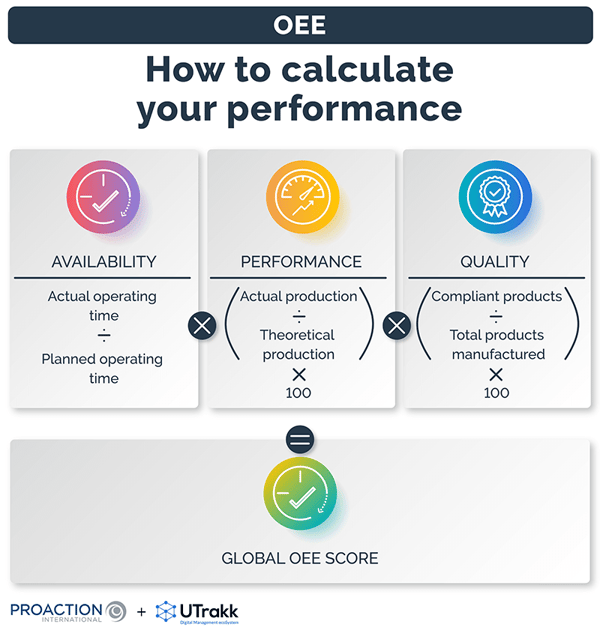
The OEE score is calculated by multiplying availability, performance, and quality. Here is the formula:
Availability
Availability measures the amount of time production equipment spends performing scheduled tasks over a given period. It is essential for assessing the overall efficiency of machines or production lines.
Availability = Actual operating time / Planned operating time
- Actual operating time corresponds to the period during which the equipment was actively used for production. It excludes unplanned downtime and preventive maintenance periods.
- Planned operating time (or scheduled production time) represents the time during which the equipment is expected to be in service for production, assuming no availability losses.
High availability contributes to better resource utilization and reduced unplanned downtime.
Performance
Performance measures equipment efficiency by comparing actual and theoretical production over a given period. This metric is crucial for assessing the extent to which a machine or production line operates at its maximum production potential.
Performance = (Actual production / Theoretical production) x 100
- Actual production represents the quantity of products manufactured over the production period.
- Theoretical production is the quantity of products a machine or production line should ideally produce over a given period if it operates without any loss of time or quality.
A performance of 100% means that equipment is operating at total capacity, without any loss.
Quality
Quality measures the conformity of products manufactured by a machine or production line over a given period. It is used to assess the equipment's ability to produce products that meet specifications and quality standards.
Quality = (Compliant products / Total products manufactured) x 100
- Compliant products represent the percentage of products with zero defects that meet established specifications and quality standards.
- Total products manufactured refers to the total quantity of products produced during a given production period.
A quality of 100% means that all products are compliant, without production defects.
Key performance indicators (KPIs)
In addition to OEE, many manufacturing KPIs are essential for measuring your plant's performance, including Mean Time Between Failures (MTBF) and Mean Time To Repair (MTTR).
MTBF measures the average time between equipment failures such as machine breakdowns. For example, if an equipment ran for a total of 2,000 hours over a month, suffered four breakdowns, and had a total uptime in lost hours of 20 hours, the MTBF calculation is:
MTBF = (2,000 - 20) / 4 = 495 hours
MTTR (Mean Time To Repair) assesses the average time needed to repair an equipment or a machine after a breakdown. For example, if an equipment suffered ten breakdowns over a month and the total repair time for all these breakdowns was 100 hours, the MTTR calculation is:
MTTR = 100 hours / 10 breakdowns = 10 hours per breakdown
How UTrakk helps manufacturers track and improve OEE
OEE software is designed to collect data on equipment efficiency and productivity on the shop floor. The UTrakk solution easily integrates with systems such as Worximity, Wonderware, TrakSYS, Epicor, Redzone, and Rockwell Automation, enabling real-time performance tracking and efficient operational performance management, on a single platform:
- Availability
- Performance
- Product quality
- Downtime
- Number of units produced
- Production cycle time
- Defective units
- And more

Available on all mobile devices, UTrakk supports managers throughout their daily shop floor tours by providing them with a digital checklist that includes control points and OEE metrics to monitor.
While conducting floor tours, managers can access production dashboards displaying up-to-date OEE data in real time. This allows them to quickly identify variances, defects, and downtime, and take immediate action to solve manufacturing or productivity issues.
The combination of UTrakk DMS solution and OEE systems gives managers powerful capabilities for optimizing operations, reducing waste, and improving operational performance.

Improve OEE to boost manufacturing performance
Overall Equipment Effectiveness is a key metric for manufacturing companies seeking to maintain their competitiveness. While improving OEE requires continuous effort and commitment from the entire organization – from management to frontline employees – as well as the establishment of a culture focused on operational excellence, the benefits are well worth the investment.
Manufacturers that implement systems and routines to improve OEE benefit from increased productivity, better resource utilization, reduced production costs, greater customer satisfaction, and a stronger position in increasingly competitive markets.
By combining the strategies outlined in this article with regular monitoring of OEE and other manufacturing KPIs, your plant can achieve significant gains in efficiency, productivity, and profitability, better equipping it to address current and future industry challenges.